Category Archives: Literary Magazines

Opportunity for Young Authors & Artists

Sunspot Literary Journal is now open for a special edition showcasing younger authors and artists. Anyone under eighteen should submit using this form.
Accepting fiction and nonfiction including essays, memoir, and travel; microfiction, flash, short stories, poetry, lyrics, teleplays, film and stage scripts; photography and art.
Maximum length is 3,500 words; individual poems and lyrics should be two pages or less. One piece per submission, please.
Share this post with your local schools!

Sunspot Lit’s C*nt Contest Winners

When Sunspot decided to launch an annual contest focused on a single word that would change every year, they deliberately selected a divisive word. They expected that having “cunt” in the title, even when they replaced the vowel with an asterisk, would create problems publicizing the contest, and that turned out to be correct.
They hoped that the focus on an inflammatory word would generate creative responses from authors and artists worldwide. The role of women in different societies, gender identity and fluidity, and human rights are, in some ways, the defining issues of our times.
The creative community responded with powerful works that blew the staff away. The tone of various pieces ranged from angry to empowered, from jackhammer decibels to whispering calm. In every case, the undercurrent lifted veils and carried all people toward a climactic resolution.
The significant quality of so many entries confounded the final judging process. There simply was no way to choose between the top two entries. The decision, therefore, was to declare two winners. As promised in Sunspot’s guidelines, the cash award was not split; it was doubled.
First place for a poem went to Morrow Dowdle for “To Russia with Love.” First place for artwork went to Valyntina Grenier for “Over His Eye.”
The winning entries will be published for the first time in the next edition of Sunspot Lit. The winners will be featured on the website, as well. They each received a $50 cash prize and the awe of the staff.

$100 for 100 Words Contest Closing Soon

Microfiction, micro essay, micro memoir, short poem, micro script, micro screenplay…if it’s 100 words or less, it might be worth $100. No restrictions on theme or category.
First place winners and finalists in various prose categories will be published in Sunspot Literary Journal. A byline and bio will be included, and select pieces will receive special attention on the website.
Enter as many times as you like. One piece per submission. Pieces must be unpublished except on a personal blog or website. Simultaneous submissions accepted. Work can have won other awards without being disqualified. Cash award of $100. Closing July 30, 2019.

Sunspot Lit Image Contest Winner

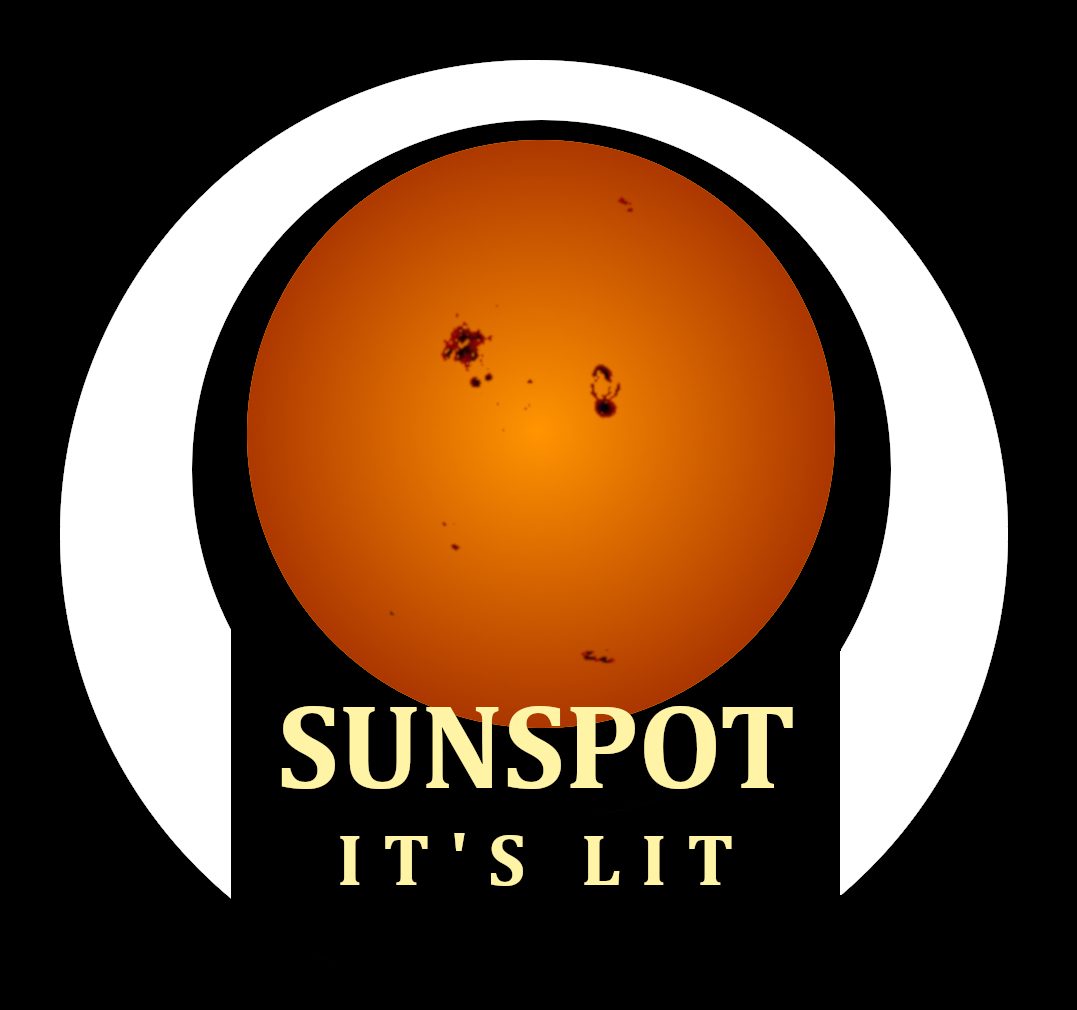
Sunspot Literary Journal reached out to the creative community for an image that represented the journal’s mission: Hearing Every Voice, Writing a New World.
The magazine received a number of spectacular entries. The final judging round turned out to be very difficult. The works varied in tone and approach, and each had so much to offer.
Timothy Boardman submitted the winning image. Timothy describes himself as predominantly a fine arts artist and printmaker with some design sensibilities who’s currently a student at UNCG in North Carolina. Here are his thoughts on the image:
“The center of the image is a gradient based sun, very simple, with a series of sunspots placed on the logo. The encircling white around the sun in this design are representative of the light, [Sunspot Lit’s] light, emanating from these sunspots, and giving voice to all. The slogan, ‘It’s Lit’ is a somewhat humorous, witty use of wordplay to represent your literary focus, while also being very straightforward about who you are as a literary journal. … I also noticed your website uses a lot of oranges, yellows, and whites, so I used them as the dominating color choices for the design.”
Timothy received the cash prize of $40 and Sunspot’s undying adoration. The image will appear in newsletters, on SunspotLit.com, and in the journal’s publications.

Fantastic Books to Help the Environment

You really have to see TREE and RIVER, both from Blotter Books, an imprint of The Blotter literary magazine. Each title contains a poem that has been lavishly illustrated by members of the Orange County artists’ community.

$25 each; available in Chapel Hill / Carrboro at the North Carolina Crafts Gallery, the Botanical Gardens, FRANK Gallery, and indie bookstore Flyleaf Books.

Online orders, contact m_k_smith@yahoo.com.  If you order online, the shipping is free!

Sunspot Lit and Other Opportunities

Sunspot Literary Journal got a boost from Submittable​ this week in their listing of opportunities for writers and artists. Thanks!

V1 I1 March 2019 Cover Image

Sunspot Lit Inaugural Edition Free Download

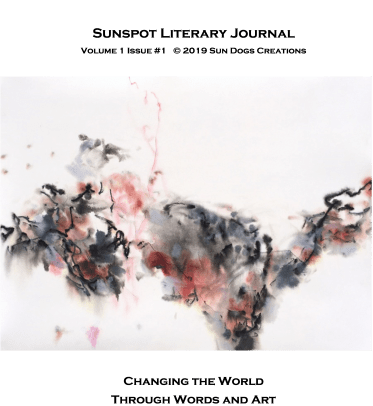
V1 I1 March 2019 Cover ImageThe inaugural edition of Sunspot Literary Journal is now available. Featuring art, flash fiction, poetry, photos, short stories, and essays from around the world.

Download the PDF free on SunspotLit.com under the Editions tab. Newsletter subscribers get early access, direct delivery of the quarterly editions to their inbox, and a carefully curated selection of news about creativity in the world.

Check back on the website as the journal selects specific artists and authors from the inaugural edition for a Spotlight feature.

Sunspot’s current open call closes May 31, 2019. Don’t miss the $100 for 100 Words contest. This is a paying market.

100 Bucks for 100 Words Writing Contest

greeting-1936817_1280Sunspot Literary Journal currently has three contests open to authors and artists. The newest pays $100 for 100 words. Continue reading

Contest for Authors and Artists

C*nt Contest for Authors and Artists from Sunspot Literary Journal

Words are important. Words are so powerful that certain ones have been weaponized to use against specific groups of people.

C*nt is one of many, but in the world today, it is more incendiary than ever. Submit a story, essay, poem, or art piece that talks about c*nt in your life:

-When did you first encounter the word?

-Have you taken on this word and ones like it as a rallying cry?

-Have you ever used it to refer to someone else?

Send your rants, your ribald comedy, a poem, or a photo that cuts to the core. You do not have to use the word within your submission as long as you are conjuring the essence of some element of this word and its use.

All submissions for this contest will be compiled for a special edition of Sunspot Literary Journal. First place winners and two runners-up from each category will be published in summer of 2019.

All first-place winners will be considered for a cash award. The best of the best will receive $50.

The C*nt Contest is now open for submissions. Deadline: March 31, 2019.

Sunspot Literary Journal Logo Contest

Sunspot Literary Journal has launched and needs a logo that can be used on the digital and print editions as well as the website.

Submit your best idea for a logo that fits with our mission: Hearing Every Voice, Changing the World Through Words.

Poke around our website for details on Sunspot’s approach. Then submit your best idea.

Submit as many times as you like to this contest. Winner receives $40, coverage in the first edition, and coverage on the website.

Tin House to Close; Sunspot to Open

books-2158737_1920June of 2019 will see the last Tin House literary magazine roll off the presses. After twenty years publishing original fiction, nonfiction, and poetry, Tin House is saying goodbye.

The move was done in the face of mounting costs associated with print publishing. Rob Spillman, the co-founder and editor, is moving on to other areas. The closing brings an end to a very long stretch of quality contributions to the literary arena.

While some new works will still be published on Tin House’s website, the loss of yet another print publication is difficult for writers. Much of the industry still gives more weight to credits in print publications, so the loss of even one magazine can be bad news.

There is a bright spot, however. Sunspot Literary Magazine is launching in January of 2019. For the first year, one print edition will be published. The magazine hopes to add additional print editions in subsequent years.

Meanwhile, digital editions are scheduled for every quarter. The founder is also considering adding frequent special editions that focus on a single author or a single category.

The magazine’s mission is to “change the world through words,” and is open to new and established authors and artists. Submissions of short stories, flash fiction, poetry, essays, art, interviews, and reviews of books, movies and galleries are being accepted through Sunspot’s Submittable portal.

This is an excellent opportunity to be heard and to enact the change you want to see.

New Literary Journal Sunspot Open for Submissions

Sunspot Literary Journal is launching at the beginning of 2019. Submissions are already open for fiction, nonfiction, poetry, and hybrid forms. (Links to their website and the submission portal are at the bottom of this blog entry.)

Words speak truth to those in power by drawing on the power of every human being. Sunspot, intent on being a force for change, hears every voice. Write a new world with words…your words.

Now accepting:

Fiction Without Boundaries

Flash fiction, poetry, shorts of every length, literary works and genre stories are welcome at Sunspot.

Essays That Expand

Send your lyric essays. Offer up thoughts that blind. If it’s unique, Sunspot wants to consider it.

Poetry

Poetry can run any number of pages. Yes, that means Sunspot will consider epic poems and stories-in-verse.

For more details about the journal, visit their website SunspotLit.com.

To submit brilliant, unique work that moves across the universe, go to their submission portal on Submittable.

Interview with Jendi Reiter, Author and Cofounder of WinningWriters.com

Winning_Writers_logoToday we have a real treat. Jendi Reiter, one of the cofounders of WinningWriters.com, set aside a generous amount of time to answer some burning questions. The site and its newsletter are fantastic resources for authors of every type. It was great to be able to ask about their mission and how authors can get help just by signing up to their free newsletter.

Best of all, two of her books are currently on sale! So, after reading all about the newsletter and the great resources, you can snap up copies for yourself. Links are at the bottom of this post!

You started Winning Writers back in 2001 with Adam Cohen. Now you have quite a staff, each of whom handle different areas or programs. How do you find such great people?

Thanks for the kind words about our amazing assistant editors and judges. A great thing about being an online business is that we can work with freelancers from all over the country—or the world!

We found two of our Best Free Literary Contests database editors, including our current editor Samantha Dias, through the Western New England Editorial Freelancers’ Network. Sam is diligent, creative, detail-oriented, and proactive about brainstorming ways to improve the database. Find her on LinkedIn for your academic editing jobs, but don’t take her away from us!

Several of our past and current contest judges were prizewinners in those same contests. We invited them because they were already in tune with the contest’s aesthetic, and the skill level of their own work gave us confidence in their ability to recognize quality entries.

Others were local writer friends, such as award-winning poet Ellen LaFleche, or friends of friends—we joke that one of our babysitters is the Winning Writers HR director because she’s recommended several people we ended up hiring. Nearly everyone in Northampton is a writer or knows a writer, it seems!

Additionally, we reach out to subscribers whose work we admire, like 2017 fiction and essay judge Judy Juanita, and contacts that I’ve made through my poetry and fiction publications, like poetry contest judge Soma Mei Sheng Frazier, who was the editor of OSA Enizagam when one of my stories won their contest.

WW offers several contests every year with significant prizes. What is the thought process behind taking on so many contest programs, considering that most arts organizations offer only one?

Something for everybody! We’re always tweaking our contest offerings in response to perceived demand and the gaps we see in the marketplace. The free Wergle Flomp Humor Poetry Contest is fun to judge, generates signups for our email list, and originally also had a scam-busting mission. (The vanity contest that inspired it has since gone out of business—we must be powerful!) There aren’t many contests for parody and humor poems, and the few that exist tend to prefer G-rated light verse that isn’t super original, in my opinion.

Everyone loves a good general-interest poetry and prose contest, so those are consistent earners for us, with over a thousand entries apiece in a good year. The North Street Book Prize for self-published books is meant to signal-boost great books that don’t have the insider connections and marketing budget to compete with major publishers in the marketplace.

Self-published, indie, and print-on-demand (POD) books are often at a disadvantage or straight-up ineligible for prestigious literary prizes. Meanwhile, the book awards programs that do welcome indies have large fees and frequently no cash prize—what are you paying for? We believe indie authors deserve better.

Your section on Contests and Services to Avoid is set up for very good reasons. I have noticed that a number of good organizations are suddenly demanding that authors who submit–whether they win, place, or are simply part of the ones who never make any short- or longlist–give them rights to publish part or all of their work. Often these nonprofits claim that the publications will help support the organization and their contests. What do you think of this approach, when it is taken by an otherwise respectable organization?

I am completely against this approach. No author should have to sign away their intellectual property merely for the privilege of entering a contest. If you don’t win or get published, the work you submitted to the contest is stuck in limbo—you can’t try to make money off it elsewhere, on the off chance that this contest will someday use it. At that point the contest starts to look like a scam to acquire a lot of free work from authors, instead of paying freelancers to contribute to their website or journal.

I especially dislike this trend when the contest advertises itself as “free” up front, and the rights grab is hidden in the long list of rules. I always push back against this when contest sponsors ask to be listed in the database, and I’m happy to report that sometimes they change the rules.

What, in your opinion, is the best part of heritage (i.e., traditional) publishing today?

Access to major distribution and marketing channels is an important advantage that will continue as long as reviewers, booksellers, and other gatekeepers persist in their prejudice against print-on-demand and self-published books.

Best part of the indie route?

More control over the content and book design. Not having to shop your manuscript around for years to an agent or traditional publisher.

What do you enjoy most about working on WW?

People send me free books! I get paid (more or less) to read interesting poetry and prose and to think critically about what makes it work, or not work. This is good for my development as a writer. I also love the opportunity to connect with writers and editors around the world.

What part would you like to see become easier, or larger, or farther-reaching?

We would like to see a more diverse entry pool for all of our contests. Except for the book prize, they’re all judged anonymously, but white ladies somehow end up in the majority in our winners’ lists. We’re working on our outreach to minority writers’ communities, as well as inviting judges from different backgrounds to join our contest staff.

What exciting things are in the pipeline for WW?

By popular demand, we’re adding two new categories to our 2018 North Street Book Prize for self-published books: poetry and children’s picture books. The other categories are creative nonfiction/memoir, literary fiction, and commercial/genre fiction.

Our 2018 final judge for the Tom Howard/John H. Reid Fiction & Essay Contest will be Dennis Norris II. He is a 2017 MacDowell Colony Fellow, fiction editor of Apogee Journal, and co-host of the podcast Food 4 Thot, a brilliant (NSFW) series with four multiethnic gay poets discussing literature and their love lives.

Jendi Reiter is the co-founder of WinningWriters.com, an online resource site for creative writers, named one of the “101 Best Websites for Writers” (Writer’s Digest, 2015-2016) and one of the “100 Best Websites for Writers” (The Write Life, 2016).

TN C 11 02Jendi’s award-winning books include the poetry collection Bullies in Love (Little Red Tree Publishing) and the novel Two Natures (Saddle Road Press), the spiritual coming-of-age story of a NYC fashion photographer during the 1990s AIDS crisis. Two Natures is on sale for 99 cents in Kindle and iBooks editions through October 15, 2017.

WW Newsletter: Thanks for your interest in Winning Writers! Sign up for the free monthly e-newsletter to receive access to The Best Free Literary Contest database, and join 96,000 Twitter followers.


Link

Death Throes Webzine

Posted: 04 Apr 2013 11:35 PM PDT

Death Throes Webzine is a new online, weekly publication that specializes on dark fiction. Our stories range from suspense to dark horror and everything in between.
Link

stinkwaves magazine

Posted: 31 Mar 2013 06:49 PM PDT

looking for YA/middle-grade fiction, poetry, illustrations