Author Archives: Laine Cunningham

Unknown's avatar

About Laine Cunningham

Laine Cunningham is an award-winning author, ghostwriter, and publishing consultant who has been quoted on CNN Money, MSNBC.com, FoxNews.com, and other national and international media. Her work has won multiple national awards, including the Hackney Literary Award and the James Jones Literary Society fellowship. She has received dozens of fellowships and residency slots from programs like the Jerome Foundation, the Vermont Studio Center, the New York Mills Cultural Center, Wildacres Center for the Humanities, Arte Studio Ginestrelle in Assisi, Italy, the TAKT Kunstprojektraum in Berlin, Germany, Fusion Art in Turin, Italy and The Hambidge Center. She is also the author of the travel memoir "Woman Alone: A Six-Month Journey Through the Australian Outback" and a series of Zen and Wisdom books combining unique inspirational text with beautiful photos.

Interview with Jendi Reiter, Author and Cofounder of WinningWriters.com

Winning_Writers_logoToday we have a real treat. Jendi Reiter, one of the cofounders of WinningWriters.com, set aside a generous amount of time to answer some burning questions. The site and its newsletter are fantastic resources for authors of every type. It was great to be able to ask about their mission and how authors can get help just by signing up to their free newsletter.

Best of all, two of her books are currently on sale! So, after reading all about the newsletter and the great resources, you can snap up copies for yourself. Links are at the bottom of this post!

You started Winning Writers back in 2001 with Adam Cohen. Now you have quite a staff, each of whom handle different areas or programs. How do you find such great people?

Thanks for the kind words about our amazing assistant editors and judges. A great thing about being an online business is that we can work with freelancers from all over the country—or the world!

We found two of our Best Free Literary Contests database editors, including our current editor Samantha Dias, through the Western New England Editorial Freelancers’ Network. Sam is diligent, creative, detail-oriented, and proactive about brainstorming ways to improve the database. Find her on LinkedIn for your academic editing jobs, but don’t take her away from us!

Several of our past and current contest judges were prizewinners in those same contests. We invited them because they were already in tune with the contest’s aesthetic, and the skill level of their own work gave us confidence in their ability to recognize quality entries.

Others were local writer friends, such as award-winning poet Ellen LaFleche, or friends of friends—we joke that one of our babysitters is the Winning Writers HR director because she’s recommended several people we ended up hiring. Nearly everyone in Northampton is a writer or knows a writer, it seems!

Additionally, we reach out to subscribers whose work we admire, like 2017 fiction and essay judge Judy Juanita, and contacts that I’ve made through my poetry and fiction publications, like poetry contest judge Soma Mei Sheng Frazier, who was the editor of OSA Enizagam when one of my stories won their contest.

WW offers several contests every year with significant prizes. What is the thought process behind taking on so many contest programs, considering that most arts organizations offer only one?

Something for everybody! We’re always tweaking our contest offerings in response to perceived demand and the gaps we see in the marketplace. The free Wergle Flomp Humor Poetry Contest is fun to judge, generates signups for our email list, and originally also had a scam-busting mission. (The vanity contest that inspired it has since gone out of business—we must be powerful!) There aren’t many contests for parody and humor poems, and the few that exist tend to prefer G-rated light verse that isn’t super original, in my opinion.

Everyone loves a good general-interest poetry and prose contest, so those are consistent earners for us, with over a thousand entries apiece in a good year. The North Street Book Prize for self-published books is meant to signal-boost great books that don’t have the insider connections and marketing budget to compete with major publishers in the marketplace.

Self-published, indie, and print-on-demand (POD) books are often at a disadvantage or straight-up ineligible for prestigious literary prizes. Meanwhile, the book awards programs that do welcome indies have large fees and frequently no cash prize—what are you paying for? We believe indie authors deserve better.

Your section on Contests and Services to Avoid is set up for very good reasons. I have noticed that a number of good organizations are suddenly demanding that authors who submit–whether they win, place, or are simply part of the ones who never make any short- or longlist–give them rights to publish part or all of their work. Often these nonprofits claim that the publications will help support the organization and their contests. What do you think of this approach, when it is taken by an otherwise respectable organization?

I am completely against this approach. No author should have to sign away their intellectual property merely for the privilege of entering a contest. If you don’t win or get published, the work you submitted to the contest is stuck in limbo—you can’t try to make money off it elsewhere, on the off chance that this contest will someday use it. At that point the contest starts to look like a scam to acquire a lot of free work from authors, instead of paying freelancers to contribute to their website or journal.

I especially dislike this trend when the contest advertises itself as “free” up front, and the rights grab is hidden in the long list of rules. I always push back against this when contest sponsors ask to be listed in the database, and I’m happy to report that sometimes they change the rules.

What, in your opinion, is the best part of heritage (i.e., traditional) publishing today?

Access to major distribution and marketing channels is an important advantage that will continue as long as reviewers, booksellers, and other gatekeepers persist in their prejudice against print-on-demand and self-published books.

Best part of the indie route?

More control over the content and book design. Not having to shop your manuscript around for years to an agent or traditional publisher.

What do you enjoy most about working on WW?

People send me free books! I get paid (more or less) to read interesting poetry and prose and to think critically about what makes it work, or not work. This is good for my development as a writer. I also love the opportunity to connect with writers and editors around the world.

What part would you like to see become easier, or larger, or farther-reaching?

We would like to see a more diverse entry pool for all of our contests. Except for the book prize, they’re all judged anonymously, but white ladies somehow end up in the majority in our winners’ lists. We’re working on our outreach to minority writers’ communities, as well as inviting judges from different backgrounds to join our contest staff.

What exciting things are in the pipeline for WW?

By popular demand, we’re adding two new categories to our 2018 North Street Book Prize for self-published books: poetry and children’s picture books. The other categories are creative nonfiction/memoir, literary fiction, and commercial/genre fiction.

Our 2018 final judge for the Tom Howard/John H. Reid Fiction & Essay Contest will be Dennis Norris II. He is a 2017 MacDowell Colony Fellow, fiction editor of Apogee Journal, and co-host of the podcast Food 4 Thot, a brilliant (NSFW) series with four multiethnic gay poets discussing literature and their love lives.

Jendi Reiter is the co-founder of WinningWriters.com, an online resource site for creative writers, named one of the “101 Best Websites for Writers” (Writer’s Digest, 2015-2016) and one of the “100 Best Websites for Writers” (The Write Life, 2016).

TN C 11 02Jendi’s award-winning books include the poetry collection Bullies in Love (Little Red Tree Publishing) and the novel Two Natures (Saddle Road Press), the spiritual coming-of-age story of a NYC fashion photographer during the 1990s AIDS crisis. Two Natures is on sale for 99 cents in Kindle and iBooks editions through October 15, 2017.

WW Newsletter: Thanks for your interest in Winning Writers! Sign up for the free monthly e-newsletter to receive access to The Best Free Literary Contest database, and join 96,000 Twitter followers.


On seeing and being seen

Yesterday I came across a New York Times article about a guy who listened to all the records on NPR’s list of greatest music by women. Whenever he talked about his dedication to hearing all the music on the list, people were shocked that he would be listening to “women’s music.”
Now, “women’s music” is, according to him, a genre that (as he describes it) is one woman and a guitar. Folksy, perhaps. But specific. And not the kind that is widely popular.
Even though he constantly said no, he was listening to “music by women” rather than “women’s music,” the misunderstandings continued.
It reminded me, painfully, of the idea in publishing and among readers (and reviewers, and art organizations that provide awards) that fiction about women is “women’s fiction” (i.e., chick lit or romance or fill in the blank with whatever genre is currently considered the lowest of the lowbrow). Or, on the wildly mistaken far end of that opinion, that fiction written by women is also always women’s fiction.
Then my partner, who is a woodworker and is reading the book of a woman who has made a name for herself as a woodworker, shared this article.
Let’s change publishing, fiction, and reading (and thus the world) by having parity for women in publishing options, review options, marketing deals, and awards opportunities.

International Bestsellers, September 2017

Just thought some of my subscribers might like to see what fellow readers are buying overseas:

International Bestsellers, September 2017

Guest Post: Writing and Travel Boost Brain Power

Here’s a great guest post from Rita Robinson, an author and journalist.

Writing and Travel Boost Brain Power

Rita Robinson

Lone Horse Rider


Lightening flashed, thunder roared, and unrelenting rain bombarded our 21-foot RV as we crept along at about 20 miles per hour on I-40 near Nashville, Tennessee. We could barely see the windshield wipers slapping across the front window, and finally took an off-ramp toward a crowded Flying J truck stop.

Andy, my husband, squeezed our small RV in among the big rigs jammed side-by-side at the truck stop, while a steady stream of other trucks parked along the adjoining road, and the parking lots of nearby churches. The truck stop, without electricity and using generators, kept everything, except the gas pumps working, as it became the hub of activity for all who parked vehicles in the area.

Portions of I-40, a main interstate highway for cross-country truckers, eventually flooded, causing closures, during the news-making, and record-breaking torrential storms in May of 2010 in Tennessee.

Once the sun shown three days later, and the sweet smell of grass and spring flowers permeated the air, a mélange of people gathered outside the station’s restaurant chatting and shaking hands as if all had known each other forever. We felt rejuvenated, and ready to continue our trip.

Stimulate Writing by Breaking Routines

Such is the stuff of travel and also writing. We change our routines or plans, and consider it part of the travel or writing experience. Not that routines are bad, but it’s good to break them once in a while.

A few times traveling, with tornado warnings ahead of us, we’ve changed routes. We had once driven through a town hit by a tornado and had seen an RV like ours that had been thrown on top of a barn.

These types of experiences make us acutely aware of our surroundings, feelings, motivations, and the idea that we’re not always in charge. As writers, Andy and I know that writing also leads to adventures.

Change and Surprise Boosts the Brain’s Power

We’re at our best when we surprise ourselves with what we put on the page. Writing transports us, as if on a magic carpet, to places of delight, anxiety, fright, awe, insight, imagery, depth, spectacle, and unanticipated adventures, virtual or real. As Robert Frost said, “No surprise in the writer, no surprise in the reader.”

“Traveling new places, meeting different people and taking part in variety of lifestyles, including foods, shops, noises, and cultures, stimulates cellular connections and promotes brain resilience, so important to the health of your brain,” says Paul D. Nussbaum, Ph.D., Brain Health Center,  and Clinical Neuropsychologist and Adjunct Professor of Neurological Surgery, University of Pittsburgh School of Medicine.

Could this be why so many noted writers have also been travelers, or vice versa? Consider Mark Twain’s, The Innocents Abroad. He wrote “Travel is fatal to prejudice, bigotry, and narrow-mindedness, and many of our people need it sorely on these accounts. Broad, wholesome, charitable views of men and things cannot be acquired by vegetating in one little corner of the earth all one’s lifetime.”

Out of Our Comfort Zones

It does not take traveling great distances to jazz up the writing mind. Changing minor routines at home can give the brain’s neurons a kick in the synapses. Sitting in a different chair than usual; eating something never tried before; walking backward; changing the writing location, maybe from a customary desk to the kitchen table; sitting on the floor to write; or writing by hand on a tablet, removes our comfort zone and fires up the brain.

Published writers have composed in coffee shops, bus terminals, airplanes, on couches in front of TVs, sitting beneath cherry trees, at the beach, in prisons, and just about any place the imagination can travel.

Emily Dickinson wrote in an attic, Ben Franklin in a bathtub, and several have written in bed, including Marcel Proust (Remembrance of Things Past) and Barbara Cartland, prolific writer of conservative romance novels.

The editor-in-chief of a newspaper where I once worked knew about the beauty of making minor changes to jazz up a place. About every six months he would stomp out of his glassed-in office with, “OK, time to change our desks around.” We grumbled, since most had piles of other work to do. All, however, pitched in to push and shove desks and chairs to new locations with new views, and across from someone different. It worked, and we laughed at the feel of that kick in the synapsis.

We’re on an adventure when we travel, or when we write, and being open to change and surprises not only recharges the brain, it enriches our lives.

Discount Sale on Urban/Dystopian Fantasy Sparks Price War Between Amazon and Google

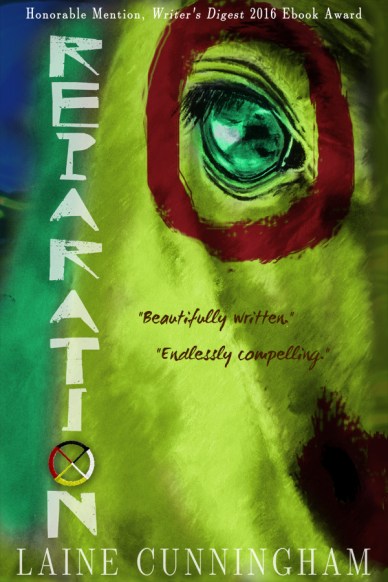
So, like many folks, my novels occasionally go on sale. Right now, Reparation’s ebook is on sale until October 3 (links at bottom of this post). Usually, this is where I would give you the book’s slugline, which is:

ReparationEbookHaruki Murakami’s 1Q84 meets Mark Helprin’s Winter’s Tale as a man battles sinister forces associated with a Native American peyote cult.

I would also inform you that the work has won a national award, and that the usual ebook price is $9.99.

Now, here’s where things get interesting.

The sale price was made available through two ebook channels: Amazon and Google Play. Both provide worldwide distribution, and both offer fast and easy access for readers.

Usually the buying choice is entirely about habits and preferred methods. Some folks like to run all their purchases through Amazon. Others prefer Google, while another set don’t display any particular loyalty.

Today, with Google’s continual efforts to pry their way further into the book market, we see one clear step they are taking to gain more share: beat Amazon’s price. Importantly, this will be done without dropping the revenue earned by the book. So, everyone wins…especially the ecosystem that provides readers with more choice through more distribution channels.

Where will you buy today? Let me know, and we’ll see if the sales figures back you up!

Now, finally, about Reparation!

A beautifully written supernatural story—the work of a master craftsman.”
“Endlessly compelling. A fascinating fusion of forms.”

“Whatever is dangerous, let me do it…I am supposed to die.”

When Aidan Little Boy leaves his ailing mother’s side to visit his sister on a peyote church property in South Dakota, he encounters a religious cult run by an apparently superhuman leader. Suddenly his nondescript life becomes tangled in a world that has grown disturbing and strange.

In a series of remarkable events, the ancient beings of Native American folktales are manipulated by people with strong connections to the parallel world of spirits. Soon Aidan uncovers evidence that his sister and the rapidly growing congregation are in danger. He must understand these unknown powerful forces before the Reparation, a ceremony that will slaughter thousands of innocents.

This complex and surreal novel merges folktales, history, and contemporary lifestyles with magical realism in a hypnotically addictive original tale.

Honorable Mention, Writer’s Digest 2016 Ebook Award

Currently discounted on Amazon and Google Play. At the time of this post, Google is beating Amazon’s price by $0.48!

Grab it now, because these deep discounts won’t last long!

Giveaway: Amazon Gift Card & Book Swag

Head’s up, everyone! Kim Peterson, an urban fantasy/paranormal romance author who was highlighted for great book sale prices here and here, has sweetened the deal. Now she’s offering a signed copy of Angels & Vixens, an Angels & Vixens tote bag, and a $20 Amazon gift card.

Go here to take advantage of this great giveaway. Hurry! The deal runs for only 13 more days!

Another Great Deal for Urban Fantasy/Paranormal Romance Thriller

Last week, I told you about a great preorder deal from Kim Petersen. Now I want to let you know that you can get another book from the same author for a great price.

This one, usually $3.99, has “steamy scenes and dark themes.” Grab it now at this great lower price! It’s called Millie’s Angel. Here’s the description:

Betrayal is always the last place you expect.

When her mother decides to leave, Millie’s life is turned upside down as she faces life with a father who has a mysterious dark pallor shrouding his countenance. Millie grows up relying on her own strength and the comfort that comes from a friend and a romantic connection that has her heart smitten.
As she struggles to make sense of life, Millie discovers her growing thirst for love while learning to overcome the adversity that plagues her family.
When Millie discovers the dark secrets surrounding her birth, she realises the unthinkable acts of her father, and finds herself battling between love and hatred while finding a sense of balance through a powerful bond with an angel.
When her mother contacts her a decade later, Millie visits with her just in time to realise her own angelic gift, when she finds she is not alone in discovering her mother’s whereabouts. With evil lurking between the cracks in her family, the appearance of Millie’s gift – a phenomenon that will heal and shine brighter than she could ever have imagined – changes her family’s perspectives and the direction of their lives forever.

And here’s the link to the discounted ebook.


Free Sample and Slashed Preorder and Launch Price on Urban Fantasy/Paranormal Romance Thriller

A&D coverI’ve just come across a great deal for all you urban fantasy and paranormal romance thriller fans. This is the latest from Kim Petersen, who has several novels out already. That’s great because once you’ve seen this one, you can binge read all her books!
Angels & Vixens has it all: a brother lost in dreams, a budding romance, and the reappearance of old troubles with a black witch conjuring for the dark side.

Here’s the description:

Her love has no limits.
His vengeance knows no bounds.

With her brother Ace dangerously lurking in her dreams, Millie finds herself captive in a delicately woven love-triangle between past desires and her faithful fiance. When she finally decides to follow the path which beckons her heart, Ace and his black witch lover sweep into town; leaving a poisonous trail of death and vengeance in their wake.
Millie’s life blackens as her brother’s vendetta becomes her reality and she is drawn into a savage game where the stakes are higher than she could have ever imagined. Can she save her brother from the evil that clutches his heart before he is lost to her forever?  And will the men in her life learn to accept her truths?

Now, if you’re like me, you want to read a bit to make sure the book is for you. So, the author has provided samples from the beginning here.

Stay tuned for another great deal from this author posting on Sep 25. Mark your calendars!


Do Good and Get Fee Stuff!

In just a very short time, North Carolina Kindness_FrontCoverfinalforwebresidents will be able to do some good in the world and possibly win free stuff at the same time!
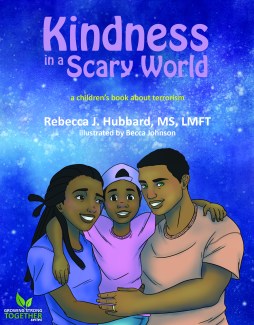
An author is coming to North Carolina to read from her new book. The work is a children’s picture book that tackles a very tough subject: how to talk to young kids about terrorism.

I was honored to be able to work with the author, Rebecca Hubbard, while she wrote this story. We have worked on an entire series together, all of which help parents and kids face difficult issues.

This event is for the launch of the entire series. The book, Kindness in a Scary World, is full of heartfelt moments. Anyone who has wondered how to help kids understand tragic events should come!

This event includes freebies that are very cool. One is a raffle for a signed print featuring one of the illustrations from the book. There will be drawings for other prizes. All proceeds from the raffle benefit the Center for Child and Family Health.

Sept. 15 th 6:00-8:00pm
Center for Child and Family Health
1121 W. Chapel Hill Street Suite 100, Durham, NC

Author Interview: Dr. Barbara Culp

As mentioned in last week’s post about great books for the back-to-school season, now we’re going to hear directly from Dr. Barbara Culp herself.

Culp Teachers

Dr. Culp started out as a preschool teacher before teaching at the elementary and middle school levels. The area superintendent promoted her until she became the principal of one of the largest elementary schools in Georgia.

After retiring, she found that education was a field she could never leave. She returned to work as a field supervisor of aspiring teachers before founding a tutorial service. The books she has written allow her to reach out to everyone who is focused on academic excellence.

More than four decades of experience have been distilled into this series. Each of the comprehensive books targets teachers, principals, superintendents, parents, and students with thoughtful, relevant advice. Readers empower themselves with wisdom from an educator who has been where they want to go.

She kindly took a break from her busy schedule to answer a few questions for this blog.

How would your advice for new writers differ from advice you would offer writers who have been in the game for a while?

To a new writer, I would say it takes time to fine tune your writing skills. Don’t give up, because your passion and purpose will take you places you never dreamed of.

To a seasoned writer, I would say you owe it to your voice in the world to mentor others who have a calling on their lives to write.

When you take a break from writing, is it a full and total break or is your mind constantly parsing the world for fodder? What does that parsing look like? How does it make you feel as an artist? As a human being?

For me, my mind is constantly at work searching within and without looking for more thoughts and information to fill the void with respect to the project I’m currently working on. It resembles an outline or table of contents; it is part of the whole that inspires more.

It makes me feel that I have something of value to add to the big picture of reading and writing and, as an artist, I am challenged to always put my best foot forward.

From your perspective as an author, what do you feel is the biggest challenge to the publishing industry today? Is there a way to solve that challenge?

I think the greatest challenge to publishers is to get people reading again. In a world where technology rules, reading a book seems to be the last thing people want to do.

I hate to offer this suggestion, but the right incentives usually motivate people to doing things they might not do on their own…so, hide messages in books that lead to monetary rewards/incentives or put books on audio to be listened to as we travel to and from.

What books are you currently reading?

I am currently reading the Bible and The Moses Code.

Which authors do you think are underappreciated in the current market, and why? (The authors do not have to be living.)

I think James Baldwin was an underappreciated Black author during his time, and that was one of the reasons why he left America and moved to France. If he were living today, his novels would probably be bestsellers as he had a tendency to speak about human sexuality as it exists in the world today.

Which new writers do you find most interesting, and why?

Michelle Alexander is a new author, civil rights attorney, and Professor of Law at Ohio State University who wrote a book titled The New Jim Crow. She spotlights racism based on her insight as a civil rights lawyer. In her book, she helps us to see the imbalance in our justice system when it comes to race in America.

Culp Principals

Finding the discipline to keep writing can be tough. Which “get writing” techniques are most effective for you?

Believe it or not, I believe I write best when I am bored or depressed. When I am feeling low, I can write my way back to a place of happiness, self-acceptance and self-reliance. The ideas, words, and thoughts seems to just flow.

Can you give us a sneak peek into your current project?

Again, my next project is school/workplace related, and it centers on building highly effective and efficient operating teams in support of greater student success.


Books for Back to School Needs!

Culp Parents

Here are six fantastic books just in time for your back-to-school needs. If you’re a parent or a student, Dr. Barbara Culp has written books specifically for your needs. Teachers, principals and superintendents of public and private schools–and anyone interested in understanding how schools work so that you can help your kids achieve the best academic results–can dive into a lot of wisdom in books targeting their needs.

The series of six books, published by Rowman & Littlefield, distills forty years of experience into practical, affordable tips. By mining her broad educational background, Dr. Culp provides support, inspiration, and empowerment.

This series is a true “must read” for aspiring, new, and seasoned educational professionals, parents, and students. Rich with real-world examples, each title contains user-friendly tips that lead to solutions, resolutions, and effective action.

  • Essential Knowledge for Teachers: Truths to Energize, Excite, and Engage Today’s Teachers keeps professionals focused and relevant in today’s changing educational landscape. 
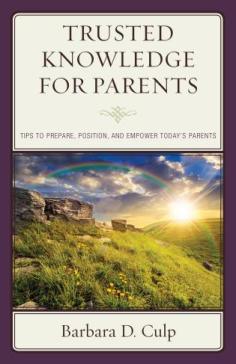
  • Trusted Knowledge for Parents: Tips to Prepare, Position, and Empower Today’s Parents provides clarity, inspiration and support for raising compassionate, respectful, and productive children.
  • Choice Knowledge for Students: Words to Empower, Enliven, and Enrich Your Life enhances the confidence, maturity, and motivation that drives success.
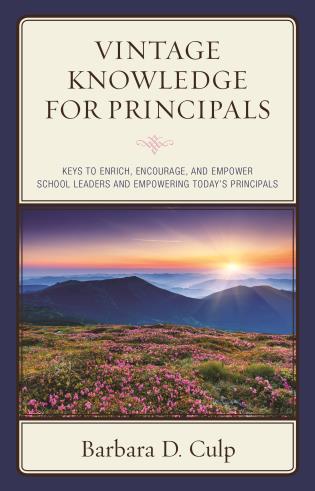
  • Vintage Knowledge for Principals: Keys to Enrich, Encourage, and Empower School Leaders and Empowering Today’s Principals provides authoritative solutions, resolutions, and actions for school leaders.
  • Culp StudentsThe Art of Appraisal: Effective Tools and Streamlined Process to Boost Teacher Performance distills the evaluation process into a structured, step-by-step system developed by Dr. Culp.
  • Key Knowledge for Success: Solutions to Augment, Fortify, and Support Today’s Superintendents provides simple and effective knowledge that will supercharge district success.

Stay tuned because next week, I’ll have an interview with Dr. Culp. She’ll tell us more about her writing process, and provide exclusive tips for authors and readers!

Scammers Break The Kindle Store

This is an issue that everyone who uses Amazon–to buy anything from toilet paper to books and gardening equipment–needs to know about.

Audiobook Toolkit

Today, we have a fantastic guest blog post from Becky Parker Geist. She’s been working on audiobook software and interesting options for audiobooks for a very long time. Now all that work has been distilled into a webinar authors can benefit from. Here’s what she has to say:

Audiobooks are the fastest growing segment of the publishing industry, with industry leaders projecting 40% growth over last year, following an unprecedented 31% growth 2015-2016. This is prime time for making sure your book is also in the audiobook distribution channels!
But many independent authors are uncertain about where to start. Should you narrate the book yourself or get a professional to do it? What are the challenges with doing it yourself, and how could you prepare yourself for success? What options are available? How do you figure out if it will be worth the time and cost and effort? Where can you turn for guidance and answers to all those questions that keep you from moving forward and getting it done?
Audiobook expert Becky Parker Geist, who also serves as President of Bay Area Independent Publishers Assn, will be joining Joel Friedlander, an independent publishing industry leader, for a live, information-rich webinar on Wednesday, 3/16, 1 pm PST, 4 pm EST. Spaces are limited and they fill up fast! Claim your spot at bit.ly/aubkwbr.

Interview with Christopher Zoukis, Author of Federal Prison Handbook

Interview with Christopher Zoukis, prison rights advocate and author of Federal Prison Handbook: The Definitive Guide to Surviving the Federal Bureau of Prisons.

How would your advice for new writers differ from advice you would offer writers who have been in the game for a while?

When it comes to those new to professional writing, I would say that you need to read what you want to write and also read a lot about how to refine your craft and market yourself. It’s hard to get going in this industry. But with a lot of time and effort, it is certainly possible to make a name for yourself. The key is in understanding the type of writing that you want to write and how to market your brand within that arena.

As for those who have been in the industry for a while, the game is changing. It used to be that if a book wasn’t published by one of the Big Six that it didn’t stand much of a chance. Now, even if a book is published by a large publishing house, it still might not stand much of a chance. New technologies and avenues of connecting with readers are the wave of the future. Harness these tools, think outside the box, and figure out how to get your expertise (or flavor of fiction) to the end user in a manner that they want. The current era is that of the hybrid author — an author both traditionally published and self-published. There is a strong argument for pursuing the hybrid path in today’s market.

When you take a break from writing, is it a full and total break or is your mind constantly parsing the world for fodder? What does that parsing look like? How does it make you feel as an artist? As a human being?

As a writer I feel that I’m an odd sort. I’m all on or all off. So, when I’m all on, I write like my life depends on it. I outline, create a self-imposed quota system, and muscle to the finish line. I’ve found that when working this way it is important to take time off. This is why I try to vary my tasks, and to cycle whenever I can. I go from books to articles to book reviews to interviews and so forth. I also try to build in projects that aren’t writing-related. I work out, play Ultimate Frisbee, and try to schedule a little time each evening to hang out with a friend to decompress.

One word of wisdom that I would offer aspiring book writers (and those who have already published their works) is to really think about what type of book the world really needs. I always have five books in the back of my head. They are all worthy, at least in my not-so-humble opinion. But when it comes to devoting a year of my life to something, I need to select a project that is going to succeed. So, when deciding what to do next, a writer should really think about the reader and the industry. What is missing? What do readers crave? And is there a book that readers don’t even know that they want, but won’t be able to live without once they have it? This is the book that you need to write next.

From your perspective as an author, what do you feel is the biggest challenge to the publishing industry today? Is there a way to solve that challenge?

Making money as a writer is a challenge. Most of us will never be New York Times bestselling authors. That’s the truth of it. So, we need to find a way to make our writing work for us and pay the bills. As a nonfiction author, one way to do this is to use your book as a business calling card, which draws attention to your primary product — which may not be your book. Writers who want to live a comfortable life need to plan on not making a whole ton of money on their books, but to structure their books and businesses in such a way that a revenue channel can be capitalized upon.

What books are you currently reading?

I tend to read a lot of school books these days due to being a graduate student at Adams State University. So, typically I’m reading a lot of business textbooks. I just finished a book on organizational behavior last week and am about to start a book on managerial finance shortly.

I also engage in a healthy amount of non-school reading. Right now I’m reading the Magisterium series of novels by Holly Black and Cassandra Clare. These are phenomenal books. They remind me a lot of Harry Potter. I’m also reading Journalistic Writing by Robert M. Knight to help hone my craft a bit and Bigger Leaner Stronger by Michael Matthews to upgrade my fitness knowledge.

Finding the discipline to keep writing can be tough. Which “get writing” techniques are most effective for you?

I try very hard to cycle my projects, because I find that I get burned out very easily. So, the best “get writing” technique that I have is to vary my projects. A close second is to outline and implement a self-imposed quota system. If I’ve outlined a 20 chapter book, then I might push myself to complete a chapter every week or two. Then, after the rough draft is down on paper, I might set a quota of polishing one chapter every week. This quota-based system helps me push myself to project completion. In this respect, I’m very business-like with my writing projects. I like to think of myself as a project manager who needs to ensure that the writing project is done on time, at an appropriate level of quality, and that it fulfills my readers’ needs.

Can you give us a sneak peek into your current project?

Sure. If you swing by PrisonerResource.com you can check out my Federal Prison Handbook. In this book I’ve tried to answer all of the questions that a new or seasoned federal prisoner, as well as their loved ones, may have. You can also use the “Look Inside” feature on Amazon.com. This provides readers with a sample of the book prior to purchase.

Book Review: Federal Prison Handbook by Christopher Zoukis

Book Review for Federal Prison Handbook: The Definitive Guide to Surviving the Federal Bureau of Prisons by Christopher Zoukis.

Published by Middle Street Publishing, January 2017.

Hands down, this is the single most useful and informative book you’ll ever find on what it’s really like inside the federal prison system. Not only is it packed with information, it’s written in the personal voice of a prison rights activist who is currently serving time at a federal facility.

Author and advocate Christopher Zoukis is an incredibly prolific writer. He regularly appears on Huffington Post, New York Daily News, and Prison Legal News. He’s able to break down the bewildering volume of rules, regulations and details so that anyone—a convict new to the federal system, their family and friends, and even individuals who’ve been in for years—can learn everything they need to know to survive behind bars.

In addition to providing a nearly encyclopedic review of the official regulations, Zoukis tells readers what others won’t: how to navigate prison culture. Family members and friends discover exactly what their loved ones are going through along with different ways they can help. Personal anecdotes and the stories of other inmates make Federal Prison Handbook an intimate, honest, and compelling read.

Tomorrow, an interview with Zoukis will be posted. As an award-winning author who has been honored by the PEN America Center, he has a lot of tips to offer other writers of fiction and nonfiction. Meanwhile, link here for his website and here for the Federal Prison Handbook.